
Community
One dead, another injured after shooting at northwest Houston apartment complex
By David Nguyen
Advertisement · Why this ad?
Laura has over 15 years of experience covering local news across Texas. A graduate of Texas State University, she has previously worked for the Houston Chronicle and was the editor at a local NPR affiliate. She is passionate about community stories that highlight the diverse voices of Pasadena.
More from Laura →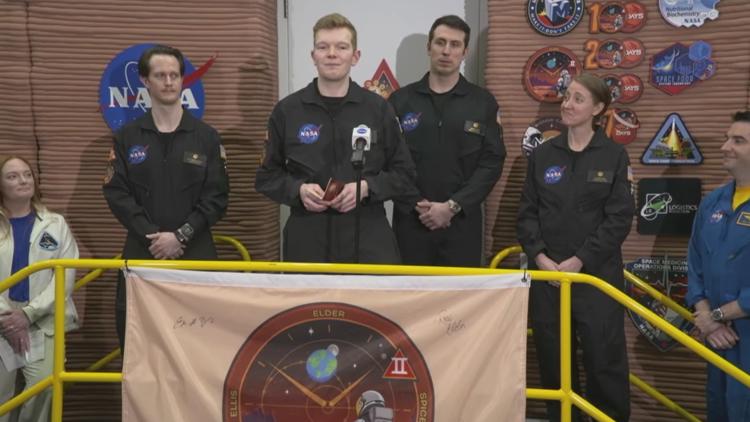
As the sun dipped below the horizon, casting a warm glow over the Houston skyline, four brave souls emerged from a year of isolation, their faces a mix of relief and exhilaration. They had just completed a groundbreaking experiment that took them far beyond the confines of Earth, living in a 3D-printed habitat designed to simulate life on Mars. This extraordinary journey was not just a scientific endeavor; it was a testament to human resilience, commitment, and the spirit of exploration.
In a project led by NASA and the Johnson Space Center, the four volunteers—known as the CHAPEA crew—spent an entire year living in a habitat that mimicked the harsh conditions of the Martian environment. Their mission was to gather data on how isolation affects human behavior and performance, crucial information for future missions to Mars. The crew members, who ranged in age and background, faced challenges that tested their physical and mental limits, all while being cut off from the outside world.
The CHAPEA experiment took place in a specially designed habitat located in the heart of Houston, where the volunteers had to navigate daily tasks such as growing their own food, conducting scientific experiments, and maintaining their living space. This immersive experience was intended to replicate the challenges future astronauts will face on Mars, where resources are limited, and communication with Earth will be delayed.
The completion of this year-long mission has resonated deeply within the Pasadena community and beyond. Many local families gathered to welcome the volunteers back, celebrating their courage and dedication to advancing space exploration. For the residents of Pasadena, this project symbolizes the potential of human ingenuity and the importance of community support in scientific endeavors. The excitement was palpable, with banners and signs welcoming back the crew, and local businesses even offering discounts to celebrate their return.
“We are so proud of these individuals,” remarked Mayor Jeff Wagner, who attended the welcome home event. “Their sacrifice and commitment inspire us all to dream bigger and reach for the stars. This project not only pushes the boundaries of science but also unites our community in a shared vision of exploration.” The mayor's sentiments echoed throughout the crowd, where local residents shared stories of how the mission had inspired them personally.
Families with children expressed their excitement, hoping to inspire the next generation of scientists and astronauts. “It’s amazing to think that people from our community are part of something so significant,” said local teacher Maria Hernandez. “I want my students to understand that they can be a part of history, too.” The local school district is already planning a series of workshops and presentations where students can learn about the mission firsthand, featuring guest speakers from the CHAPEA crew.
This mission is not just about exploring Mars; it’s about understanding the human experience in extreme conditions. As the volunteers shared their stories of camaraderie, challenges, and personal growth, they highlighted the importance of teamwork and resilience—values that resonate deeply within our families and communities.
During their time in isolation, the volunteers faced moments of doubt and difficulty, but they emerged stronger, more connected, and with a renewed appreciation for the simple joys of life. “We learned to rely on each other, to communicate openly, and to find joy in small victories,” shared crew member Dr. Emily Chen during a recent interview. “These lessons are invaluable, not just for space missions but for our everyday lives.” The crew's experiences are being compiled into a documentary that aims to reach wider audiences, illustrating the human side of space exploration.
Each crew member has a unique story that adds depth to the mission. For instance, crew member Mark Simmons, a former engineer, spoke about the challenges of adapting to life in isolation. “At first, it was overwhelming. I missed the little things, like the sound of birds or the feel of sunlight on my face. But as time went on, I learned to appreciate our environment and the people I was with,” he shared, highlighting how the experience reshaped his perspective on life. Another member, Dr. Lisa Patel, a psychologist, emphasized the importance of mental health during their isolation, noting that they implemented daily routines that included exercise, meditation, and group discussions to maintain morale.
The CHAPEA mission is just one of many initiatives aimed at preparing humanity for the challenges of space exploration. As NASA continues to plan for future missions to Mars, the data collected from this experiment will play a critical role in shaping the strategies for long-duration space travel. The insights gained about mental health, teamwork, and resource management will be foundational for future astronauts.
Moreover, this project has sparked a renewed interest in STEM (science, technology, engineering, and mathematics) careers among local students. Schools in Pasadena are already planning programs to engage students in science and engineering, inspired by the bravery of the CHAPEA crew. Local organizations are collaborating with the Pasadena Independent School District to create after-school programs that focus on robotics, coding, and space science, aiming to cultivate a new generation of innovators.
For families interested in getting involved with STEM education, local organizations like the Pasadena Independent School District and the Houston Museum District offer a variety of programs and resources. These initiatives aim to foster a love for science and exploration among young learners, ensuring that the legacy of the CHAPEA mission continues to inspire future generations. Upcoming events include science fairs, guest lectures from scientists, and hands-on workshops that will allow students to explore the wonders of space and technology.
As we look to the stars, let us remember the stories of those who dare to dream and venture into the unknown. The CHAPEA crew has not only contributed to our understanding of space but has also reminded us of the strength found in community, commitment, and faith. Their journey serves as a beacon of hope and inspiration, urging us all to reach for the stars and pursue our passions, no matter how far they may seem.
By David Nguyen
By Laura Gonzalez

By David Nguyen

By David Nguyen